AC Milan have appointed Ruben Amorim as their new manager, with the hopes he can lead the club into a more positive new era.
After links with Andoni Iraola, Mauricio Pochettino, Oliver Glasner and Matthias Jaissle among others, Amorim was the name that Gerry Cardinale and co. settled on. Last week, the Portuguese put pen to paper on a two-year deal with the option for a third.
Read SempreMilan ad-free and get access to exclusive news. Click here for a free trial!
Amorim has a tale of two halves as a manager. Firstly, he won five major trophies as manager of Sporting CP in his successful tenure from 2020 to 2024. It included league titles in 2020–21 and 2023–24, earning him a move to Manchester United where he did not do as well.
In part one of our analysis, Rohit Rajeev took a look at the principles Amorim instilled at Sporting which landed him one of the biggest jobs in world football. In part two he explained what did not work at Old Trafford. Now, in part three, we look ahead to what impact he could have at Milan.
Principles to carry forward
Ruben Amorim’s Sporting CP side in the 2023-24 season displayed a clear identity built around controlled possession, vertical progression, and aggressive pressing.
Ball dominance: With 57.51% possession, Sporting control most matches like a normal team in possession would with a massive share in possession.
The team consistently progressed the ball forward, as reflected by their 75.02% accurate progressive passes and 9.74 deep completed passes, showing an ability to break opposition lines rather than simply circulate possession.
Sporting however only had 7.71% of successful long passes from the 83% accurate passes which shows that Amorim likes to keep the ball on the ground more than play long passes.
Chance creation: The standout attacking metric is an impressive 2.55 expected goals (xG) per game. Combined with 32.78 positional attacks ending with a shot and 29.17 penalty-area entries, Sporting consistently generated high-quality opportunities through structured attacking patterns.
The team also created danger from wide areas, averaging 16.93 accurate crosses, while 3.88 smart passes highlighted the creativity needed to unlock compact defences.
Aggressive attack: Winning 78.26% of offensive duels suggests Sporting’s attackers were highly effective in one-on-one situations, allowing Amorim’s side to sustain attacks and dominate the final third.
Although the listed 0.9 goals appears relatively low compared to the team’s xG, this likely reflects either a specific metric rather than goals per game or a period of underperformance in finishing.
Defensive intensity: Out of possession, Sporting remained proactive. Their PPDA of 9.29 indicates a high pressing approach. 63.29% defensive duels won demonstrates strong defensive efficiency.
In addition, 34.28 interceptions reflects excellent anticipation and organisation, while 3.10 successful sliding tackles further illustrates the team’s willingness to regain possession aggressively. Rather than defending deep, Amorim’s team aimed to recover possession quickly and restart attacks.
Balanced build-up: An average pass length of 18.59 metres suggests Sporting mixed short combinations with medium-range progression instead of relying exclusively on either possession football or direct play. Combined with strong progressive passing numbers, this points to a flexible build-up style.

Player profiles needed
It’s all well and good outlining the vision for Amorim’s idea of perfect, but how can Milan get their squad into a position where it can be achieved, and in a different – arguably tougher and more tactical – league like Serie A.
Goalkeepers
➤ Goalkeepers are traditionally judged on their ability to stop shots, but modern systems increasingly demand much more from the position.
➤ At Sporting, Israel demonstrated excellent ball-playing qualities, showing composure in possession and the ability to contribute actively to build-up play.
➤ He was frequently involved in switching play and helping Sporting progress from the back, often operating almost as a third centre-back during possession phases.
➤ If Maignan remains at Milan, his profile would make him an excellent fit for Amorim’s system, given his comfort on the ball, passing range, and ability to participate in the first phase of build-up.
Centre-backs
➤ Amorim’s centre-backs are expected to defend large spaces due to the high defensive line, making recovery pace and athleticism essential qualities. Similar to how Milan benefited from the speed of Kalulu under Pioli, defenders must be capable of recovering quickly when the line is breached.
➤ In possession, Amorim places significant emphasis on ball-playing ability. His centre-backs are expected to progress play through passing rather than simply recycling possession, making technical quality a key requirement.
➤ The central centre-back in the back three carries the most responsibility. This player is typically expected to be the best passer in the defensive unit, capable of stepping into midfield to create overloads, much like Coates did at Sporting.
➤ Amorim also expects this player to organise and lead the defensive line. At Manchester United, Lindelöf was often tasked with similar responsibilities but struggled to execute them consistently.
➤ Unlike under Allegri, where defenders such as Pavlović were given licence to step forward and join attacks, Amorim generally prefers his centre-backs to maintain their positions and preserve the structure of the team. This could limit some of Pavlović’s more adventurous qualities.
➤ Gabbia possesses several defensive traits that fit Amorim’s system, particularly his positioning and defensive awareness. However, concerns remain regarding his recovery speed and ability to consistently progress the ball under pressure. Unless Amorim adapts certain aspects of his structure, these limitations could become problematic.
➤ Koni De Winter appears better suited to the profile Amorim typically seeks. His combination of mobility, recovery pace, and comfort in possession could give him an advantage over Tomori in the long term, particularly in a system that places such a high premium on ball progression from the back.
Midfielders
➤ The double pivot is one of the most important components of Amorim’s system, providing the balance between defensive stability and attacking progression. It acts as the link between the back line and the attacking unit while also protecting the team during transitions.
➤ Typically, the partnership consists of a defensive midfielder alongside a more dynamic box-to-box midfielder. At Sporting, this role was usually occupied by Hjulmand as the deeper midfielder, with Morita or Bragança providing energy, ball progression, and support in advanced areas.
➤ For Milan, Jashari appears to be a natural fit for the box-to-box role. He already has experience playing alongside a more defensive-minded midfielder at Club Brugge and possesses the mobility and technical quality required to contribute in both phases of play.
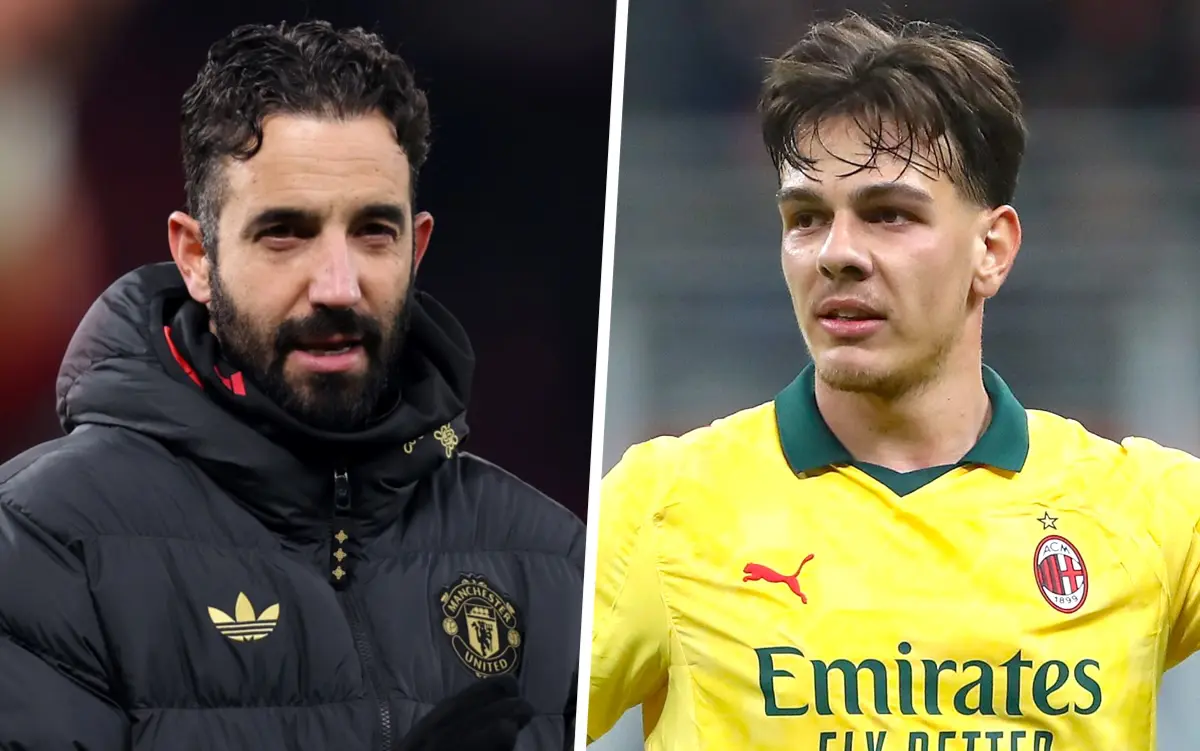
➤ In my view, Jashari offers a better balance between attack and defence than Ricci. While Ricci is an excellent passer and controller of possession, Jashari’s ability to cover ground and impact both boxes makes him a more suitable fit for the demands of Amorim’s midfield structure.
➤ The bigger issue lies in the defensive midfield position. At present, Milan do not appear to have a natural specialist capable of fulfilling the role as Amorim typically envisions it.
➤ A useful reference point would be Franck Kessié during his Milan years: a midfielder with the physicality, defensive range, and athleticism to cover large spaces while also contributing in possession. That profile is much closer to the type of player Amorim would likely want anchoring the double pivot.
Wing-backs
➤ The wing-backs are arguably the most important players in a Ruben Amorim system. More than just wide defenders, they are crucial to maintaining the team’s structure in both possession and out of possession, often determining the balance of the entire formation.
➤ Amorim’s system relies heavily on the wing-backs to provide width, support progression, and contribute in the final third, while also dropping back quickly to form a back five when defending.
➤ Typically, the two wing-back roles are not identical. On one side, Amorim often prefers a more explosive profile: a player with strong dribbling ability, high work rate, and the capacity to consistently win 1v1 duels and carry the ball forward.
➤ On the opposite flank, the role can be more playmaking-oriented. Rather than relying on dribbling, this wing-back is often expected to contribute through passing, combination play, and intelligent positioning to help circulate possession and create attacking connections.
➤ In Milan’s current squad, Athekame could be a strong candidate for the right wing-back role. His athleticism and ability to attack space fit many of the requirements Amorim typically seeks from the more aggressive wing-back profile.
➤ The left wing-back position may require a different solution. While a new signing cannot be ruled out, it will likely depend on how Amorim evaluates the existing options during pre-season.
➤ One interesting possibility is Pervis Estupiñán. Amorim reportedly admired his profile during his time at Manchester United, and Estupiñán possesses many of the physical and technical qualities suited to a wing-back role.
However, success in Amorim’s system is not solely about attributes on paper, and adapting those qualities to the demands of Serie A would present a different challenge altogether.
Forwards
➤ In Amorim’s system, the two forwards behind the striker operate primarily as inside forwards. Rather than holding width, they are expected to occupy the half-spaces and central areas, allowing the wing-backs to provide the team’s width.
➤ Their responsibilities extend far beyond attacking. Out of possession, they form the first line of defence and play a critical role in the pressing structure.
Amorim’s pressing system relies heavily on these forwards guiding opponents into predetermined pressing traps, making work rate, defensive intelligence, and tactical discipline essential.
➤ Christian Pulisic appears well-suited to this role. His ability to operate in tight spaces, press aggressively, and make intelligent off-ball movements fits many of the demands Amorim places on his inside forwards.
➤ Rafael Leão is a more complicated fit. While his individual quality is undeniable, the defensive workload, positional discipline, and constant pressing required from Amorim’s inside forwards could make the role less natural for him than it would be for other attackers.
![GoalPoint] Pedro Gonçalves is the 2nd most productive](https://preview.redd.it/goalpoint-pedro-gon%C3%A7alves-is-the-2nd-most-productive-goal-v0-kuv9o64hc70b1.jpg?auto=webp&s=d397b8d7e630a25576ca6cd21b134d6725e70f2f)
➤ Christopher Nkunku is an intriguing case. His experience in central attacking roles at Leipzig suggests he could adapt well to the off-ball demands and pressing requirements. The more interesting question is how consistently he could influence games from the narrower central positions that Amorim typically asks his inside forwards to occupy.
➤ The striker role is equally important. Amorim’s number nine must pin centre-backs, attack channels when opponents press high, and provide a constant outlet for direct balls. While elite hold-up play is not essential, the ability to receive with back to goal, protect possession, and bring teammates into play is a major advantage.
➤ Santiago Giménez possesses strong finishing instincts and penalty-box presence, but Amorim’s system demands a broader skill set from the striker. His ability to contribute in channel-running, link-up play, pressing, and overall involvement outside the box will likely determine whether he becomes a key figure under Amorim or faces increased competition for minutes.